


 Facebook
 Twitter
 Google
 Reddit
 LinkedIn
 del.icio.us
 MySpace
 StumbleUpon
 Newsvine
 Digg
Digg

CHICAGO – The Steppenwolf Theatre of Chicago continues to provide different viewpoints on the American stage, and their latest “Little Bear Ridge Road” is no exception. Featuring ensemble member Laurie Metcalf, it’s the resonate story of a family at the crossroads. For tickets/details, click LITTLE BEAR.
‘Lookingglass Alice’ a Proud Chicago Work of Jibber Jabber, Nonsensical Wonderment
Submitted by HollywoodChicago.com on July 16, 2008 - 12:43pm
 Printer-friendly version
 E-mail page to friend
 PDF version
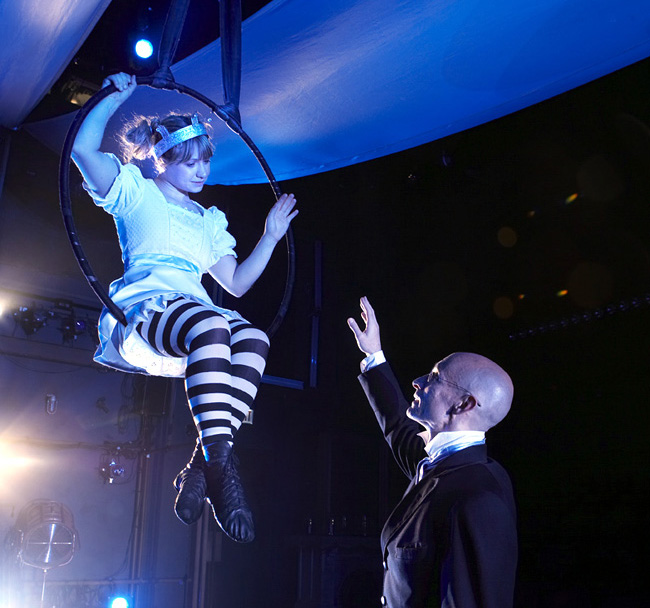
Lauren Hirte (left) as Alice and Lawrence E. Distasi as Lewis Carroll in “Lookingglass Alice”.
Photo credit: Lookingglass Theatre
“Lookingglass Alice” runs every day of the week except for Mondays and Tuesdays at various times through Aug. 31, 2008 at the Lookingglass Theatre at 821 N. Michigan Ave. in Chicago. For tickets or more information, visit here or call 312-337-0665.
 See our six-image slideshow for “Lookingglass Alice”.
For a complete listing of all shows and reviews in Chicago, visit our partner TheatreInChicago.com. For half-price Chicago theater tickets, visit our partner  Goldstar.
© 2008 Alissa Norby, HollywoodChicago.com
Printer-friendly versionE-mail page to friendPDF version
 Rating: 3.5/5.0 |
CHICAGO – On the fourth of July in 1862, Charles Lutwidge Dodgson rowed a boat up the River Thames with 10-year-old Alice Liddell. Alice was the daughter of the new dean of Christ Church where Dodgson was employed as a lecturer in mathematics.
Three years later, Dodgson (with the penname Lewis Carroll) wrote of such adventures in a book entitled “Alice’s Adventures in Wonderland”. Much like how the scholar preferred play to academe, the story of Alice celebrates the pooh-poohing of lessons and the embracing of fun-filled fantasy.
Beloved by millions, it was an unprecedented work of literary nonsense and utter surrealism. While it was adored by almost all, some critics wondered where the line between sense and nonsense should have been drawn. Now in its third year, Alice at Chicago’s Lookingglass Theatre is once again face to face with this same question. This time, though, she fails to proffer a clear answer.
Lauren Hirte (left) as Alice and Lawrence E. Distasi as Lewis Carroll in “Lookingglass Alice”.
Photo credit: Lookingglass Theatre
In “Lookingglass Alice,” director David Caitlin doesn’t fear showing his audience an Alice they could barely have dreamt of before (let alone seen before). A hybrid of both “Alice’s Adventures in Wonderland” and “Through the Looking-Glass and What Alice Found There,” the play uses both the card-deck symbolism of the former and the chess board structure of the latter to tell its story.
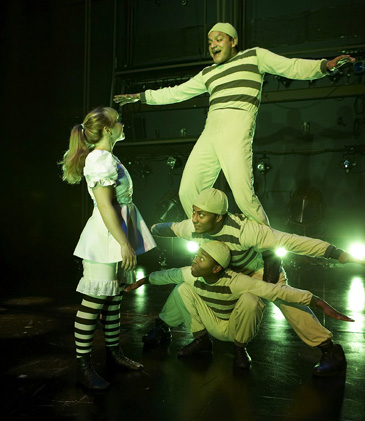 Photo credit: Lookingglass Theatre |
But perhaps what’s most obviously different about this production of Alice is not the unique combining of the novels but the influence of one of the production’s producers: the Actors Gymnasium.
In this version, the characters tumble, jump, fall and fly with the ease of some of the greatest trapeze artists of our times. When I say fly, I mean fly. There are no harnesses, bungee chords or levitating brooms.
When the terrific and audacious Lauren Hirte (Alice) takes wing, she does it about 25 feet off the ground on a mere series of ropes (all in Mary Janes and a dress). Each of her triumphs seemed so unimaginable that it noticeably had the audience thinking “curiouser and curiouser” after each twist and turn.
Caitlin clearly knows how to entertain his audience even when these gymnastic feats are put on pause. There is more tricycle riding, juggling, bouncy-ball throwing, swinging and toppling in this performance than could might feasibly fit into a room.
If it sounds like I’m describing a new “Cirque du Soleil” show that’s loosely based around a celebrated children’s story, then you’re close to the money. As mystifying and engaging as these acts are, they’re just that: acts that serve as audience eye candy.
While watching this production, you get the sense that the artists spent more time on the acrobatics than on Carroll’s classic writing. That truly is a shame (if not literary sacrilege) because the eloquent semantic riddles that comprise the Alice books are truly unparalleled and would have surely been a tasty treat for the Lookingglass audience.
Caitlin’s choice to favor physical tricks over literary treats disappointingly permeates almost all aspects of the show. While Hirte is fantastic in portraying the warm-hearted, head-in-the-clouds Alice, the ensemble actors perform their scenes with such overwhelmingly heightened energy and volume that Carroll’s witty dialogue is swallowed by their very delivery.
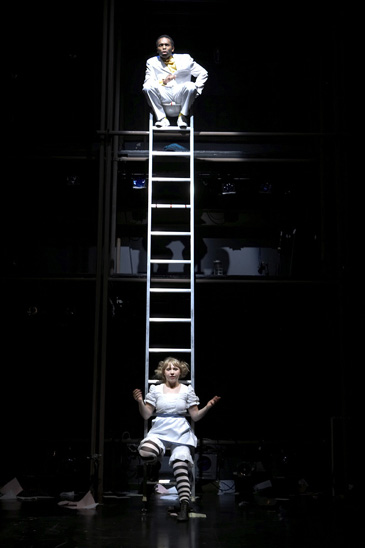 Photo credit: Lookingglass Theatre |
The humor is updated as well. Forget fantastical dialogue about Jabberwocks and mock turtles. The humor in this Alice includes jokes about fecal matter and girls having cooties.
While everyone in the audience under the age of 10 vociferously enjoyed these jokes, it did make me wonder whether Caitlin believed the audience wouldn’t be intelligent enough or sufficiently well-read to enjoy Carroll’s original humor.
However, the narrative of the piece is refreshingly new (though unapologetically foggy at points). Told through metanarration, the piece explores Alice and Wonderland in an almost existentialist style.
The actual stage managers and lighting crew schlep Alice through her adventure to show that this is in fact no longer Alice’s adventure. Instead, it’s a series of occurrences that are happening to her without her own consent.
The character of Lewis Carroll himself is present at times in the play as a kind of puppeteer who pulls the strings of the story in which Alice now naïvely finds herself.
Even the chess board that Alice must make her valiant and perilous march across is an allegory for the vanishing of innocence and the literal move from childhood to adulthood.
It is a directorial notion such as this that makes many aspects of the Lookingglass Theatre’s production ingenious.
| RELATED SLIDESHOWSee our six-image slideshow for “Lookingglass Alice”. RELATED READING More theater reviews from critic Alissa Norby.More theater reviews from our other critics. |
As fresh and different as it proudly stands, though, the piece also retains the majority of the story’s whimsy and wonder.
The kids in the audience will enjoy this familiar tumble down the rabbit hole with characters such as the mischievous Tweedledee and Tweedledum, the sultry Chesire Cat, that hookah-smoking Caterpillar (who in this production seems to be inhaling more than just tobacco), the vicious Red Queen and that White Rabbit who never seemed to set his watch just right.
At the end of the day, it’s still a story that audiences of any background and age can enjoy. Faults aside, the dream-like world of play and wonderment that the Lookingglass creates is unadulterated. By the end of the night, so many out-of-the-way things happen that you surely begin to believe that nothing is truly impossible.
See our six-image slideshow for “Lookingglass Alice”. | By ALISSA NORBY |


